LOOKLIKEME

sexta-feira, 14 de dezembro de 2018

quarta-feira, 21 de novembro de 2018
Guru Rinpoche’s advice for visualizing the deity: a how-to from Padmasambhava with advice from today’s teachers (with video how-to)
For many Vajrayana Buddhists, nothing is more difficult than generating (creating) a detailed, stable and complete visualization. Yet, at the same time, it is vital, as explained by Kunkhyen Tenpe Nyima:
This is one of the primary functions of the development stage; it is a unique method that allows one to practice calm abiding by focusing on the mind of the deity
Although some teachers reassure us that our skills will increase with experience — and in the mean time to just “know” the deity is there — never-the-less, visualization is so fundamental to the advanced path of Generation Deity Practices, it’s hard to be satisfied with only a glimpse of our Yidam. Visualization is so important that Guru Rinpoche advises us to have “a well-made painting of the yidam deity and place it in front of you.” [1]
Traditionally, if we have difficulties visualizing, this is due to “obstacles” on our path (and in our mindstream). This is one of the reasons for initiation and instruction from the teacher. The great Lotus Born Padmasambhava put it this way:
“Whether you meditate on the deity in front of you or meditate yourself as the deity, after you have received the masters oral instructions, the master should have given you, the disciple, his blessings and protected you against obstructing forces.”
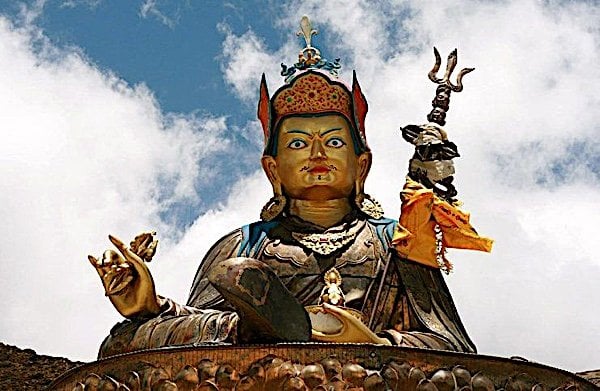
Guru Rinpoche Padmasambhava statue.
Problems with visualization
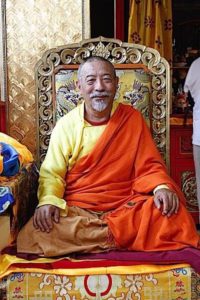
Visualization is especially diffficult for busy, modern people, with unsettled minds. H.E. Zasep Rinpoche, in a video teaching on visulizing deity, said:
“Everybody has the same problems. Everyone has the same type of difficulties, struggling. But, this is practice. This is the path. This is how it is. Don’t blame yourself, don’t blame anybody, just keep practicing. This is how everybody has to learn.”
[Full video advice follows Guru Rinpoche teachings.]
Practical advice from Padmasambhava, the great Guru Rinpoche
The advice from the Lotus Born Padmasambhava, quoted below in translated English, is from His oral instructions to Lady Tsogyal, herself a Dakini. Clearly, then, we can certainly rely on this precious advice. In his oral instructions, He advised Lady Tsogyal, to hone Her skills in this way (after we receive the blessings from our teacher):
“Next, sit on a comfortable seat and be physically at ease. Take a well-made painting of the yidam deity and place it in front of you. Sit for a short time without thinking of anything whatsoever, and then look at the image from head to foot. Look again gradually at all the details from the feet to the head. Look at the image as a whole. Sometimes rest without thinking
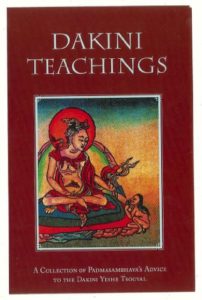
Dakini Teachings: Padmasambhava’s oral instructions to Lady Tsogyal.
about the image and refresh yourself. Then in this way, look again and again for a whole day.
“That evening take a full night’s sleep. When you wake up, look again as before. In the evening, do not meditate on the deity but just rest your mind in the state of nonthought.
“Following this, the deity will appear vividly in your mind even without your meditating. If it does not, look at its image, close your eyes and visualize the image in front of yourself. Sit for as long as the visualization naturally remains. When it becomes blurry and unclear, look again at the image and then repeat the visualization, letting it be vividly present. Cut conceptual thinking and sit.”
Five kinds of experiences in visualization: Guru Rinpoche
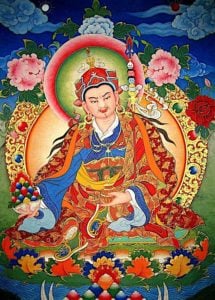
Guru Rinpoche.
“When meditating like this you will have five kinds of experiences: the experience of movement, the experience of attainment, the experience of habituation, the experience of stability, and the experience of perfection.
Experience of Movement
“When your mind does not remain settled at this time and you have numerous thoughts, ideas, and recollections, that is the experience of movement. Through that you approach taking control of the mind. This experience is like a waterfall cascading over a steep cliff.”
Experience of Attainment
“Then when you can visualize the deity for a short time with both the shape and color of the deity remaining vivid and clear at the same time, that is the experience of attainment. This experience is like a small pond.”
Experience of Habituation
“Following this, when the deity is clear whether you mediate upon it from a long or short distance, and when it remains for a sixty of your session without any occurence of gross thoughts, that is the experience of habituation, which is like the flow of a river.”
Experience of Stability
“Next, no thoughts move and you are able to maintain the session while clearly visualizing the deity. That is the experience of stability that is like Mount Sumeru.”
Experience of Perfection
“Following this, when you can remain for a full day or more without losing the vivid presence of the deity’s arms and legs even down to the hairs on its body and without giving rise to conceptual thinking, that is the experience of perfection.
Instructions to Lady Tsogyal from the Lotus Born
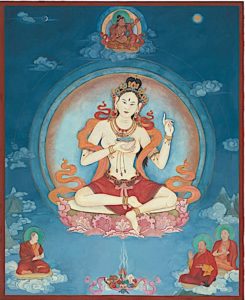
Lady Tsogyal from a tangkha by Laura Santi.
“Practioner, apply this to your own experience!
“If you sit too long with an unclear visualization of the deity, your physical constitution will be upset. You will become weary and consequently unable to progress in your concentration. You will have even more thoughts, so first refresh yourself, then continue meditating.
“Until you attain a clear visualization, do not meditate at night. In general it is important to visualize in short sessions. Meditate while there is sunlight, when the sky is clear, or with a butter lamp. Do not meditate when you just have woken up or when you feel sluggish or hazy.
“At night, get a full night’s sleep and meditate the next day in eight short sessions.
“When meditating, if you leave the session abruptly, you will lose concentration, so do it gently.
“When your visualization becomes vivid the moment you meditate, you can also practice at nighttime, during dusk, and at early dawn.
“In general do not weary yourself. Focus your mind on the visualzation, grow accustomed to it with stability and visualize the complete form of the deity.”
Video visualization advice from H.E. Zasep Rinpoche
In a short video, H.E. Zasep Rinpoche offers suggestions for students on visualization:
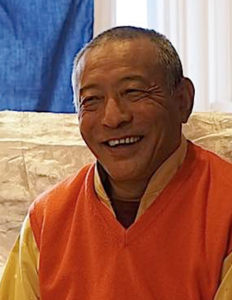
Excerpt from video teaching:
It helps achieve good visualizations faster… if you have strong faith, devotion and passion. You have to have a passion. Some people have this passion. Some people don’t have the passion, but can develop it.
When I say passion, it doesn’t mean attachment. It’s more like devotion. Devotion, joy and excitement. You can call it passion.
So, when you have that, it’s like a child, a little child, fantasizing about toys. You go to the toy shop, and all you think about are toys. Like a little boy with his toy truck.
Automatically, boom, your mind is gone. Drawn in. Because you want this, you like this, you are so excited. Yogis, or Yoginis, should have this kind of excitement or passion.
Advice on Visualizing the Deity from Kunkhyen Tenpe Nyima
“Start out by placing a painting or statue before you, using one made by a skilled artisan and with all the appropriate characteristics. Next, arrange offerings before it an practice the preliminaries. You can do the latter in a brief form, or a more etensive one; either is acceptable…” [2]
“Once this is finished, gaze at the painting or statue placed before you. Then close your eyes and visualize the image immediately, transferring it to your own body. Train by alternating between these two steps. Once you’ve gotten used to the visualization, you can refine your ability by changing its size, increasing or decreasing the number of figures, visualizing the central deity and then the retinue, and so forth. You can alternate periods of simultaneously visualizing the complete form of the deity with periods where you only focus on certain parts or ornaments.
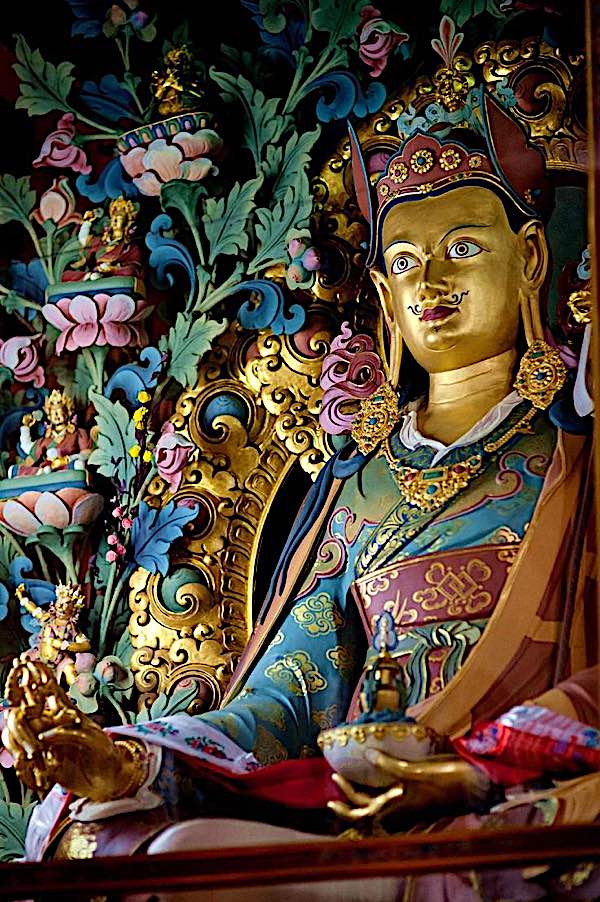
Guru RInpoche statue.
“Whichever you do, start out by focusing solely on the central deity. Starting at the tip of its crown and working your way down to the lotus seat, try to develop a clear visualization of each element: the color of its body, its face, hands and ornamentation, its clothing, the pupils of its eyes, the shape of its arms and legs, the appearance of the marks and signs, the radiation and absorption of light rays, and so on… work at visualizing all of these in minute detail.
The figure you are visualizing should not be a corporeal entity. It shouldn’t be flat like a painting or protrude like a carving, in other words. On the other hand, it should not be a mindless entity either, like a rainbow. Rather, it should be clearly defined in every respect — its front and back, left and right sides, proportions and so forth. Yet at the same time it should be devoid of any sense of materiality…
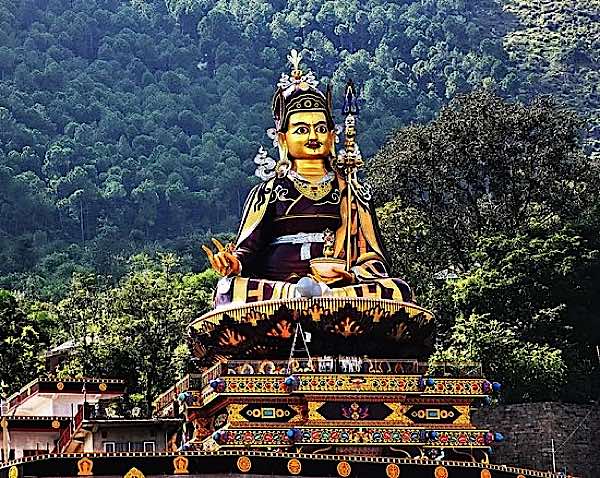
“The term “clear appearance” refers to the point at which every aspect of the supporting and supported mandala circles arise in your mind with a sense of vivid clarity. This is one of the primary functions of the development stage; it is a unique method that allows one to practice calm abiding by focusing on the mind of the deity.”
segunda-feira, 22 de outubro de 2018
sexta-feira, 5 de outubro de 2018
The Secret Guru Padmasambhava
The Secret Guru Padmasambhava
GYALWA DOKHAMPA·
- Transcription of the talk by His Eminence Gyalwa Dokhampa at the Mountain Echoes 2016
When I was about 15 years old, one of my Gurus told me that in our prayers we say that the entire universe is Guru. And he asked me if I actually understood what that means? This entire universe is Guru, this table is Guru, this chair is Guru, how dare we sit on a Guru? It took me a long time to understand what it really means when we say that the entire universe is Guru. Usually, being religious, we just accept what we hear and don’t really think about it.
So, today I want to talk about what it means when we say that the entire universe is Guru Padmasambhava. As per Vajrayana, everybody is Guru Padmasambhava. It is because of our own obscurations that we have not realized it but we are Guru Padmasambhava. When we translate the word ‘Guru’ in our Himalayan language, it means full of quality.
In Buddhism, there are three yanas – Theravada, Mahayana and Vajrayana.
In Theravada, the vinaya (body and speech discipline) is the most important. The Theravada monks don’t even look at women, they are not allowed to touch gold, they have to go begging. Therefore, for a Theravada follower, the Guru should have the quality of body and speech discipline. The Vinaya Gurus are referred to as Bikshus and Bikshunis - Khenpos/Abbot.
Then we have Mahayana in which the most important quality is the selflessness. It is given more importance than the external discipline. If you are a Mahayana practitioner, you do not have to be a celibate or a monk. You just have to be completely selfless in all aspects of body, speech and mind for the benefit of all beings. That is why Mahayana Bodhisattvas can come in any form. In Bhutan, we say all the Kings of Bhutan are Bodhisattvas – not because they are monks but because of their selfless acts of body, speech and mind. So, the most important quality of a Mahayana Guru is the quality of selflessness.
The Vajrayana is a branch of Mahayana, and this is the main practice in Bhutan. Vajrayana is in a way very complex because it is very hard to know who is a Vajrayana Guru.
Drukpa Kunley
For example, if you have heard about Lam Drukpa Kuenley (Divine Madman), he did so many crazy things. It is believed that he took the head of a goat and then put it on the bones of a cow. With a snap of his fingers, this combination became alive which is the takin, the national animal of Bhutan. He goes around drinking, and so on. It is very difficult to know a Vajrayana Guru. The essential quality of a Vajrayana Guru is to be able to pierce through the ordinary perceptions of duality, to which we are very much attached. Our own dualistic concepts of good and bad, in terms of speech - compliments and criticism, in terms of emotions - happiness and sadness etc. Emotions are very real for us. Even though it is something that does not actually exist, it is very real to us. Basically, a Vajrayana Guru must be able to go beyond the ordinary dualistic concepts. That is the quality of the Vajrayana Guru.
And today when we talk about secret Guru Padmasambhava, we are mostly talking from the Vajrayana point of view.
His Holiness the Jekhenpo of Bhutan
And I am deeply honoured that His Holiness the Jekhenpo of Bhutan is one of my root Gurus and His Holiness is the lineage holder of all the three yanas – externally, he keeps the vinaya keeping the vows of a monk and all the precepts; innerly, the selflessness and bodhicitta; and secretly, with the practice of visualization, awareness is not bound by ordinary dualistic concepts. His Holiness the Jekhenpo is considered as Sumdhen Dorji Zinpa in choekey - the one who holds the three yanas within oneself. Among my own Gurus, some are not holders of all the three yanas - some are yogis. His Holiness the Jekhenpo is the spiritual head of Bhutan and I am very fortunate to be a student of His Holiness.
In a way, it seems like vinaya is rejecting the world – you are not allowed to see women, you are not allowed to touch gold, it is like as if the world is bad. But if we understand it properly, vinaya does not reject women, does not reject the world because by rejecting something, you cannot escape from the problem. It is necessary to understand the problem to accept it and then deal with it positively. If you can free yourself from the problem by just running away, then it is very easy to get enlightened. Just divorce your husband/wife and leave home and tomorrow you are enlightened or you are homeless…I don’t know which ever. Therefore, we should understand that following the vinaya is not rejecting this world but trying to avoid unnecessary problem which one may not be able to understand and handle. It is very good for beginners like us – for example, if you cannot deal with a relationship, you don’t get into it; if you can’t handle drinking alcohol, then better not to look at the drink.
Then the Mahayana says you can touch and use the gold as long as it benefits others. You can marry, have family, whatever as long as everything is purely for a selfless purpose. In Vajrayana, it really does not matter as long as you do not have a dualist concept. These three approaches may look very different but the essence of all the three yanas is to transform the mind from the vinaya point of view and recognize the true nature of the mind from the vajrayana point of view.
The Mahayana says that it is ok if one can handle it and use all these things for the benefit of others. Even though he/she is the Prime Minister, that person can be a bodhisattva, because he/she uses the power for the benefit of others – without getting influenced and corrupted. Then in Vajrayana, even the very concept of gold is a human concept. Gold never says I am very expensive. Human beings put a cost to it and then says it is very expensive. I heard that some rich people buy very expensive diamond jewelry. Then, because it is so valuable, they keep the original in the safe and make a copy to wear and go around. Vajrayana is not about giving up the diamond but understanding that diamond is neither expensive nor cheap.
Now let’s talk about Guru Padasambhava. In Vajrayana, if you say that my Guru is highly learned, so and so bikshu, great, humble, - we say that it is not devotion but respect. It is not devotion and it is not good enough. Not good enough because that does not have much mileage. It can even make you into a kind of you know sectarian. If we start comparing our Gurus – for example by saying - my Guru is a yogi, yours is nothing; my Guru is a bikshu and very compassionate, yours is not; my Guru is handsome, your Guru is ugly – we are wrapping ourselves even more deeply into our dualistic concepts. While your aim is to break through dualistic concepts, this ordinary concepts will actually bind us. That is why in Vajrayana, we say that, to have true devotion, we must understand the Guru’s body, speech and mind as non-dualistic.
Now talking about Guru’s body, speech and mind, what is Guru Rimpoche’s body? Guru’s body, the Buddha’s form is said to be perfect. But is it really perfect, how perfect is it? Is Guru Padmasambhava very good looking and handsome? Many Bhutanese will probably say yes. Many who are not used to Guru Rimpoche will say no, he is not handsome. For some Shahrukh Khan is better looking than Guru Padmasambhava. I would say that most of the younger generation of Bhutan may say Korean actors are better looking than Guru Rimpoche. But yet, out of respect, we are supposed to say Guru Rimpoche is perfect, Guru Rimpoche is good looking.
If he is really good looking, we should dress up like Guru Rimpoche, not like the Korean actors but we don’t want to. So, when we say Guru Padmasambhava’s form is perfect, we are not just talking about how he looks, we are talking about every form that we see, even this table, house, people, dog. We are talking about the entire universe as the form of a Guru or the form of a Buddha, whatever you call it. And we are saying that the entire form is perfect. Everything is perfect by itself but by our perception and our dualistic concepts, we label everything as expensive or cheap, beautiful or ugly, etc. We are very much bound by our own concepts.
Sometimes, our concepts can be so strong that we like to even celebrate a Gorilla’s birthday, though I doubt if it understands that it is his birthday.
We human beings are so bound by our dualistic concepts that we constantly project it on others. One of my Gurus used to say that, it is amazing how our concepts rule us. While we are so attached, and feel strongly about our own concepts, we are totally ignorant to the fact that different people have different concepts and needs. That’s why you might wake up in the middle of the night when your wife is tired and say I love you even though what she needs is good sleep. She is thirsty and instead of giving her water, you may give her a rose, which will not make her happy because happiness is a concept which is dependent on the conditions and needs of the individual at that moment. That is why, when we say Guru Padmasambhava’s form is perfect, it means that by nature, everything is perfect, everything is beyond the concept of good and bad. It is very much a human concept that labels everything in terms of quality, characteristics, etc. - good and bad, positive and negative. Diamond is neither expensive nor cheap. Someone is neither beautiful nor ugly.
[Video] (https://www.youtube.com/watch?v=flHfHg6t-8I) - This video shows that even physical forms have no inherent existence and scientifically this has been proven. Scientifically, it is shown that the entire body of everything can be broken down to subatomic level. If we truly understand that even this physical form has no inherent existence, why are we bothered about good and bad, rich and poor, etc. and get upset or happy about it.
Now coming back to what it means when we say Guru Padmasambhava’s form, we are talking about the entire form of being perfect. Next, we are talking about Guru Padmasambhava’s speech. In Vajrayana, we are not just talking about Guru Padmasambhava’s speech but we are talking about everything we can hear. Someone telling you a wonderful thing as well as someone scolding you are both Guru Padmasambhava’s speech. Therefore, for a true Vajrayana practitioner, whether someone is scolding you, criticizing you or praising you, you should respect every sound. Even a fart is Guru Padmasambhava’s sound. When it comes to speech, for example, if your Boss in the office is scolding you, bossing around saying I am the Boss, why are you not listening to me and so on, we become very upset because we have a concept that I don’t want this Boss, he is always scolding me and very negative. Now, let’s look at a very romantic and friendly couple, who are so much in love.
The wife tells the husband, I am the Boss and the husband lovingly looks at the wife and says yes, you are and they look very happy. Both the scenarios are about being the boss but because sound does not have an inherent quality, the concepts are totally opposite depending on the concepts of the individuals involved. It is because of our concept that one sound makes us happy and the other makes us angry. This shows that sound by nature is beyond any inherent quality but it is our concept that determines whether you like it or not. That is why every sound is perfect. The sound that we hear from the car, plane, music, everything is perfect. Many people say that sound disturbs them when they are doing meditation. This is not true from the Vajrayana point of view. Actually, sound will disturb your meditation if you have a concept that sound is a disturbance. Otherwise, you go to a night club, the louder the better, it does not disturb you, right? Why does it disturb you sometimes and does not disturb you at other times? It is because sound by nature is neither a disturbance or a support.
Similarly, we are talking about emotions. Every emotion is Guru Padmasambhava’s thought. Emotions by nature are neither good nor bad, but concept makes them into happy and sad emotions.
For example, a farmer is very happy that it is raining and with the same rain, a tourist is very unhappy that it is ruining her site seeing. While nobody wants pain, we fail to understand that it is because of the concept of suffering that happiness exists. If you have not known poverty, wealth will never give you happiness.
That is why when we protect our children too much, trying to avoid every suffering coming their way, they actually land up never feeling joy.
We should understand that both happiness and sadness have no inherent existence, the existence of one is dependent on the other. We say that all emotions do not have inherent existence. Otherwise, how can we have a true nature of mind that is known as clear and empty in Vajrayana and Buddha nature in Mahayana.
As reference to today’s talk on the Secret Guru Padmasambhava, please refer to Soeldep Leu Dhuenpa (chapter 7), which is Guru Padmasambhava’s own words.
So, when we talk about secret Guru Padmasambhava, we are not even really talking about Buddhism. We are talking about the universe, the universal truth. That is why in Buddhism, we like to talk about the universal truth.
“Devotion is genuine when you can recognize that Guru is the non-dualistic wisdom.” If that is the case, then why do we have statues of Guru Padmasambhava? We have the statues to support us in transitioning from our strong dualistic concepts to leaving everything in their true nature. To transition from the level where we are full of concepts, to totally no concept is very difficult. We need gradual steps in between to support our transition from one level to the other. Visualizing Guru Padmasambhava and his Pureland, are considered as the middle step to support us to reach the ultimate level of non-dualism. The middle step is better than where we are right now because right now we are full of dualistic concepts- happiness, sadness, friends, enemies, and so on which gives rise to negative emotions. The pure vision is the middle ground.
Although we may not have reached that level but if we visualize everyone as Guru Padmasambhava, everyone as pure, every place as Pureland, we are doing the practice of inner Guru Padmasambhava and taking the steps to reach the ultimate or the secret non-dualistic Guru Padmasambhava. Such visualizations are skillful methods of Vajrayana and relatively speaking, Guru Padmasambhava and his Purelands do exist. For example, even though the nature of pain is not inherently existent, yet it is so real right now that tears fill our eyes, we can even get a heart attack. It is the same for happiness. As long as we are bound by dualistic concepts, pain is real and happiness is real, gold is valuable and this house is existing, so does Guru Padmasambhava exists, his Pureland exists.
quarta-feira, 19 de setembro de 2018

quinta-feira, 6 de setembro de 2018
KUNTUZAHGPO
Through Kuntuzangpo's prayer may all you beings without exception attain enlightenment in the state of dharmadhatu.
Ah Ho! Hereafter whenever a very powerful yogin with his or her awareness radiant and free from delusion recites this very powerful prayer, then all who hear it will achieve enlightenment within three lifetimes. During a solar or lunar eclipse, during an earthquake or when the earth rumbles, at the solstices or the New Year you should visualize Kuntuzangpo.
And if you pray loudly so all can hear, then beings of the three realms will be gradually liberated from suffering, through the prayer of the yogin and
will finally achieve enlightenment.
Assinar:
Postagens (Atom)